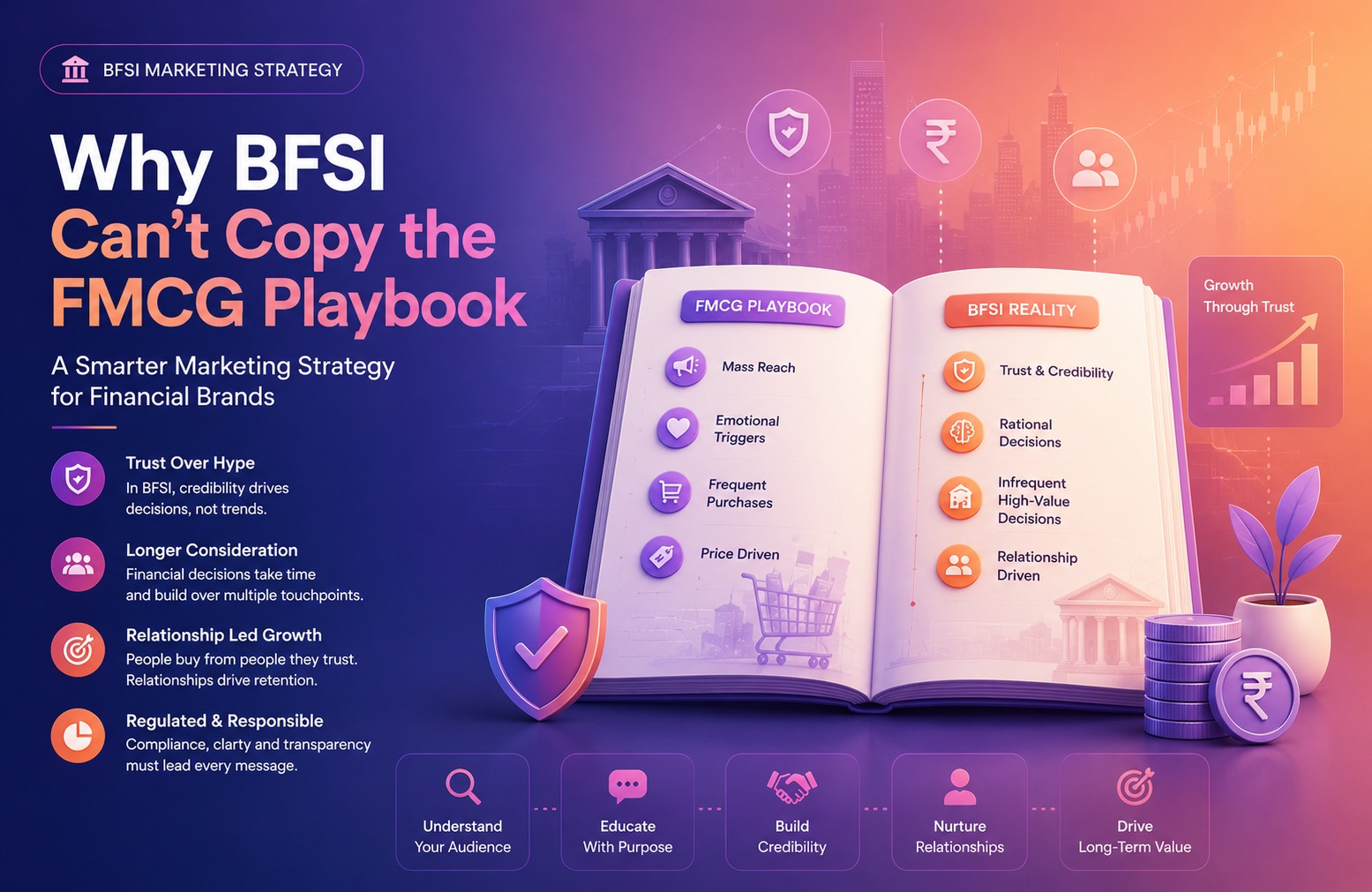

Here is an uncomfortable truth most bank marketing heads already know but rarely say out loud: A large portion of Indian banks are still running their marketing the way they did in 2014. Newspaper inserts for FD rate changes. Pamphlets at branches. Radio jingles during festive seasons. And a website that the IT team maintains and the marketing team barely controls.
Meanwhile, a 28-year-old in Bengaluru just opened a savings account entirely on his phone after watching a 30-second Instagram reel. He never walked into a branch. He never spoke to a relationship manager. He searched, discovered, evaluated, and converted — entirely in the digital space.
That gap between how banks are marketing and how their customers are making financial decisions? That is the crisis hiding inside the comfortable familiarity of traditional bank marketing. This is not a "digital is the future" article. Digital is the present. This is a "here is exactly why your bank cannot afford to wait any longer" article.
🏦 Whether you are a public sector bank with 1,000 branches, a small finance bank expanding into Tier 2 cities, or a private bank competing hard against fintech challengers, a robust bank marketing strategy built on digital-first thinking is no longer optional. It is the operating system of modern customer acquisition.
Before the 10 Reasons: What Has Actually Changed?
The shift is not just behavioural. It is structural. India now has over 750 million internet users. UPI processes more than 15 billion transactions a month. A first-time borrower in Lucknow researches home loan EMIs on YouTube before visiting any bank. A working professional in Pune compares savings account interest rates on a comparison portal before deciding where to park her salary.
Customers are no longer walking into branches to begin their banking journey. They are walking in, if they walk in at all, to complete it. The discovery, comparison, and shortlisting all happen online. If your bank is not present, visible, and compelling at those digital touchpoints, you are simply not in the consideration set.
01 | Your Next Customer Is Searching, Not Walking In
The branch-first discovery model is broken. For decades, bank marketing was designed around the branch. You planted a flag in a new location, placed a hoarding on the main road, and waited for the neighbourhood to come to you. That model worked when physical proximity was the primary factor in banking decisions. It no longer is.
A potential customer searching for a "fixed deposit with best interest rate in Pune" will encounter whatever Google surfaces — and Google surfaces the banks that have invested in search visibility. If your bank has not built branch-level landing pages, localised SEO, and optimised Google Business Profiles, you will not appear in that search. Your competitor will.
🔍 Banks that invest in local SEO and Google Business Profile optimisation for each branch consistently see measurable increases in calls, direction requests, and walk-ins — all from customers who were already actively looking for banking services nearby.
02 | Fintech Is Not Your Inspiration. It Is Your Competition.
Neobanks, lending apps, digital wallets, and fintech platforms have fundamentally redrawn the competitive landscape for Indian banking. These challengers spend aggressively on performance marketing, content, social media, and personalised digital journeys. Their target audience? The same customers your bank is trying to retain and acquire.
The difference is not just the product or the technology. It is the marketing velocity. These players run hundreds of ad variations simultaneously, optimise in real time, and speak to their audience in the language of their platforms. A traditional bank with a static digital presence and a marketing calendar built on quarter-end campaigns cannot keep pace with that level of agility.
⚡ The competitive threat from fintech is not a distant concern. It is live, active, and directly eating into account openings and wallet share. The banks that take digital marketing for banks in India seriously will hold their ground. The ones that do not will find the erosion accelerating every quarter.
03 | Trust Is Now Built Online Before It Is Felt Offline
Banking is built on trust. That trust used to be built face to face — through the quality of the branch, the professionalism of the staff, and the reputation earned over decades in a community. That trust is still built through those things. But it is now also built — and increasingly first built — through your digital presence.
Before a customer walks into a branch or calls your helpline, they have already visited your website, glanced at your Instagram, read a couple of Google reviews, and skimmed a blog or two. An outdated website, a dormant social page, poor review management, and thin content do not just underperform. They actively damage trust. In a sector where trust is the product, that is a significant brand liability.
04 | Your High-Value Products Need High-Quality Content to Convert
Not all banking products are the same from a marketing perspective. A savings account has low friction and needs awareness and convenience. A home loan, a business loan, a wealth management product, or a fixed deposit for a senior citizen — these are high-consideration decisions that require education, trust-building, and nurturing over time.
A well-structured content marketing strategy for banks addresses every stage of the customer decision journey. It answers the questions they are asking on Google. It explains the product in plain language. It builds credibility through expertise. And it creates a pathway from interest to inquiry without requiring a human touchpoint at every step.
📝 Content marketing for banks is not thought leadership for its own sake. It is a direct acquisition lever. Every blog post that ranks for "home loan eligibility in India" or "how to apply for a business loan" is a lead generation asset working for your bank around the clock.
05 | Paid Digital Advertising Offers Precision That Print Never Could
Traditional bank advertising — print, outdoor, television — has always been a broad-reach game. You pay for exposure to a large audience and accept that most of them are not in the market for your product at that moment. It is brand building, and it has value, but it is expensive, slow, and difficult to measure accurately.
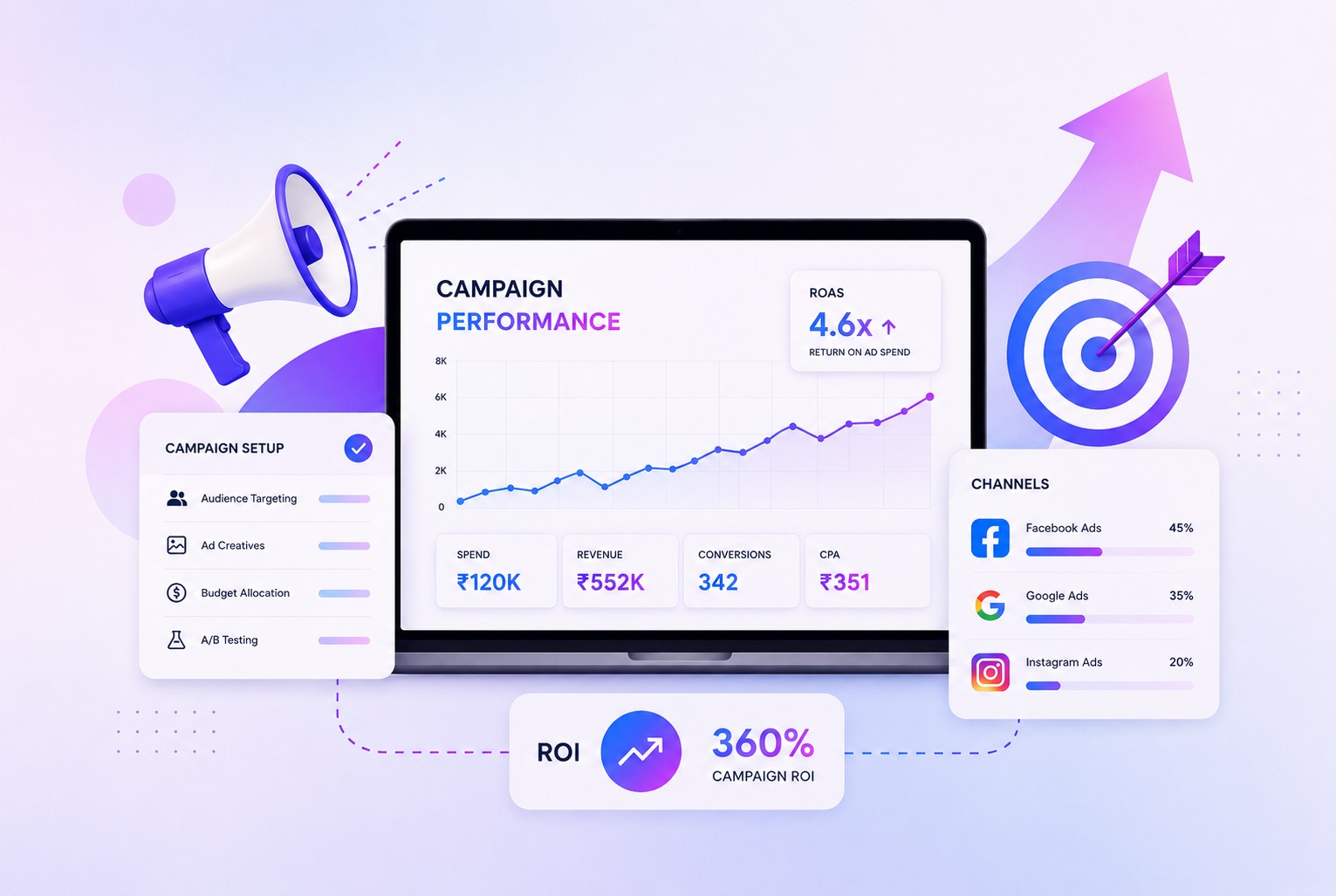
On Google Search, you can target people who are actively searching for a home loan right now, in a specific city, at the exact moment of intent. On Meta platforms, you can reach 30–45 year old salaried professionals researching investment options, in a specific PIN code, during a specific time window. You can run 20 ad variations simultaneously and know within 48 hours which one is driving the lowest cost per lead.
06 | Social Media Is How Banks Become Brands, Not Just Institutions
There is a version of social media for banks that is boring by design. Post the RBI rate change. Wish customers on Diwali. Share the new branch opening photo. Repeat. That is not a social media strategy. That is a noticeboard.
The banks that are winning on social media are using it to build genuine brand equity. They are demystifying financial products for first-time borrowers. They are creating content that a 26-year-old finds useful enough to save and share. Customers who feel a genuine connection to a banking brand are more likely to consolidate their financial relationships with that bank and stay loyal when a competitor offers a marginally better rate.
📱 At Tuskmelon, we have seen the difference between banks that treat social media as a compliance checkbox and those that treat it as a brand-building engine. The latter group consistently outperforms on awareness metrics, customer sentiment, and organic referral rates.
07 | Local SEO and Google Business Profile Are Untapped Gold Mines
Ask the average bank marketing team what their Google Business Profile strategy is, and you will most often get a blank look followed by "the IT team manages that." That is a significant missed opportunity.
For a bank with branches across multiple cities, an optimised Google Business Profile for each branch is one of the most direct and cost-efficient customer acquisition levers available. A fully optimised profile with accurate branch details, geo-tagged photos, service listings, regular posts, and an active review management process can take a branch from invisible in local search to consistently appearing in the top three results for its area.
08 | WhatsApp, Email, and CRM Campaigns Are Driving Real Cross-Sell
New customer acquisition gets all the attention. But for most banks, the highest ROI opportunity sits within their existing customer database. A customer who opened a savings account five years ago but has no other product with your bank is a cross-sell opportunity. A fixed deposit customer approaching maturity is a renewal and upgrade opportunity.
A well-structured digital CRM strategy — combining segmented email journeys, WhatsApp Business communication, and triggered campaigns based on customer behaviour — can dramatically improve cross-sell conversion rates.
- Segment by product holding: target FD holders nearing maturity with reinvestment offers
- Trigger-based campaigns: reach customers when their account balance crosses a threshold
- Life-stage targeting: first salary accounts get different content than pre-retirement customers
- Onboarding journeys: digital welcome sequences that reduce early churn and increase product depth
09 | Data and Analytics Turn Marketing Spend into a Measurable Investment
One of the most persistent frustrations among bank marketing heads is the inability to prove the direct business impact of marketing spend. Large budgets go into brand campaigns. Reports come back with impressions and GRPs. But the link between those numbers and account openings, loan disbursals, or deposit growth has always been murky.
Digital marketing, when instrumented correctly, changes this fundamentally. Every campaign can be tracked to a specific outcome. Every channel can be attributed a cost per lead or cost per acquisition. A bank running a well-structured digital programme can know, with reasonable precision, that a specific search campaign generated qualified home loan inquiries at a measurable cost per lead.
The metrics that actually matter for bank digital marketing:
| Channel | Vanity Metric (Skip) | Real Metric (Track) |
|---|---|---|
| Local SEO | Keyword rankings | Branch-level organic traffic, direction clicks |
| Google Business Profile | Profile views | Calls, direction requests, click-to-website per listing |
| Social Media | Followers, likes | Brand recall, share of voice, referral traffic |
| Paid Digital Ads | Impressions, CTR | Cost per lead, cost per account opened |
| Content Marketing | Page views | Time on page, returning visitors, lead form fills |
| Email / WhatsApp | Open rates | Conversion rate, cross-sell uptake per campaign |
10 | The Banks That Move Now Will Be Difficult to Displace Later
Digital marketing, unlike a newspaper ad, compounds. A bank that starts building its content library today will, over 12 to 18 months, have a collection of high-ranking articles, a well-reviewed Google Business presence, a social community with genuine engagement, and a database of re-marketable digital audiences. A bank that starts the same journey in 2027 will be 18 months behind.
SEO authority is not built overnight. Brand recall on social media is not built overnight. A reputation for genuinely useful financial content is not built overnight. These are long-term assets, and their value grows over time in proportion to the consistency and quality of the investment.
🌱 Tuskmelon's take: The best time to build a high-performance digital marketing engine for your bank was two years ago. The second best time is right now. The one time you cannot afford is "later."
What a Winning Bank Marketing Strategy Actually Looks Like in 2026
- Search-first foundation: Technical SEO, local landing pages for each branch cluster, and a Google Business Profile optimisation programme covering every listing.
- Content that earns trust: A structured content calendar covering product education, financial guidance, and brand storytelling — all aligned to search intent and customer life stage.
- Performance media: Geo-targeted paid search and social campaigns optimised for lead quality, not just volume, with real-time reporting and budget allocation tied to cost per acquisition.
- Social presence with purpose: Platform-specific strategies for Instagram, Facebook, LinkedIn, and YouTube that build brand equity and support acquisition goals simultaneously.
- CRM and retention marketing: Segmented digital communication journeys for existing customers that drive cross-sell, reduce churn, and improve lifetime value.
- Measurement infrastructure: A unified analytics framework that connects digital marketing activity to actual business outcomes, so every budget conversation is grounded in evidence.
None of these elements works optimally in isolation. The power comes from integration. A customer who sees your social content, then finds your branch listing on Google Maps, then reads your home loan guide before clicking on your search ad — that journey is only possible if all the pieces are coordinated. Building that coordination requires deep expertise in BFSI digital marketing.
About Tuskmelon
Tuskmelon is a Chennai-based digital marketing agency with a focused practice in BFSI. We work with banks, small finance institutions, NBFCs, and financial brands across India, helping them build digital marketing ecosystems that drive real business outcomes.
We have helped publicly listed banks improve their branch-level digital visibility, small finance banks acquire customers in Tier 2 and Tier 3 cities through targeted digital campaigns, and multi-city financial brands build the kind of content authority that holds up against fintech competition.
If you are a CMO, Head of Marketing, or Digital Head at a bank or financial institution, and you are ready to build something that actually works at scale — we would like to talk. Reach out to the Tuskmelon BFSI marketing team.