
When a bank has 2 branches, digital marketing is simple. When it has 900+, it becomes a completely different animal. You're not managing one brand presence. You're managing hundreds of micro-presences — each with its own neighbourhood, its own local competition, its own searcher behaviour, and its own set of customers who type "savings account near me" or "home loan in [city]" into Google every single day.
Most banks get this wrong. They run one national campaign, hope it trickles down to the branch level, and wonder why their walk-ins aren't improving and why their digital spend isn't converting. We've been through this. And we've built something that works at scale.
This blog is our honest account of what it takes to build a digital ecosystem for a bank operating across hundreds of cities — being completely transparent about what we did, why we did it, and what results it drove. If you're a CMO, VP of Marketing, or Digital Head at a bank or financial institution, this is the playbook you've been looking for.
First, What Even Is a "Digital Ecosystem" for a Bank?
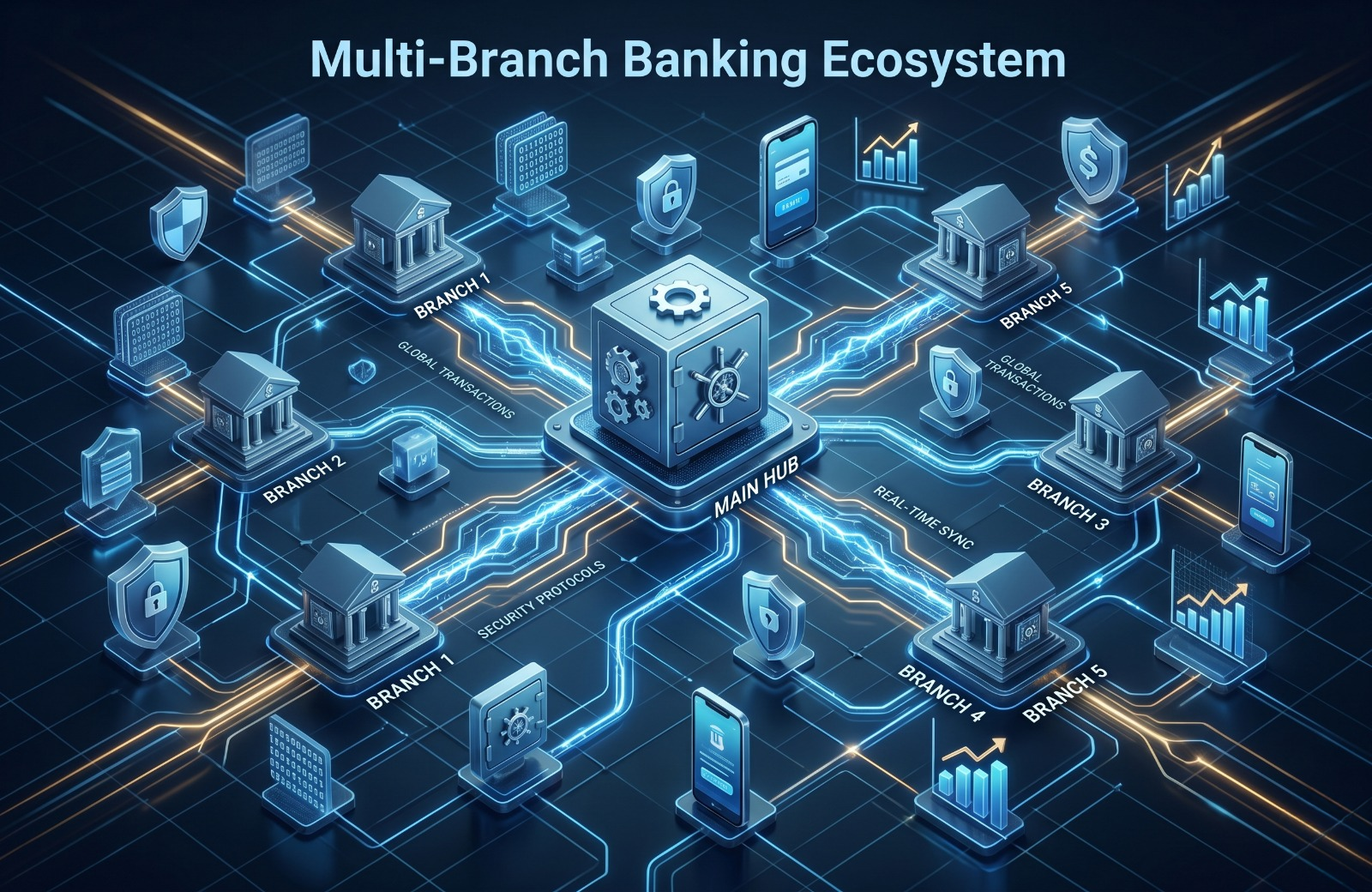
A digital ecosystem for a bank is not just a website and an Instagram page. It's the connected, coordinated infrastructure of all digital touchpoints where a potential or existing customer encounters your brand — and how those touchpoints work together to move that person from awareness to account opening (and beyond).
- Local discoverability — Can people find your nearest branch when they search?
- Search authority — Does your brand rank for the terms your customers use?
- Social presence — Are you building trust and recall on platforms your audience uses?
- Paid performance — Are your ads reaching the right person in the right city at the right moment?
- Partner networks — Are you leveraging affiliates and referral channels to acquire customers outside your owned channels?
All of these need to function together, at scale, with local precision. That's the challenge. And that's exactly what we solved.
Phase 1: Local SEO — The Foundation Nobody Wants to Do (But Everyone Needs)
The Question Marketers Ask: "Why is our branch invisible on Google even though we've been in that city for 10 years?" The answer, almost always, is poor local SEO hygiene.
Keyword Architecture for Multi-Location Banking
We built a keyword matrix mapped to real search intent — not just "home loan" but "home loan in Coimbatore," "savings account for self-employed in Madurai," "gold loan near Tambaram." The difference in specificity matters enormously at the branch level.
We identified three tiers of keywords:
- Transactional local keywords — "open savings account in [city]"
- Navigational keywords — "[Bank name] branch [area/pincode]"
- Informational keywords — "what documents needed for gold loan" / "how to apply for small finance bank loan"
For a bank with 900 branches across India, this meant building a keyword strategy that was scalable — not 900 separate campaigns, but a logical, templated architecture that could be populated intelligently.
On-Page Optimisation at Scale
Each branch or cluster of branches needed location-specific landing pages — not duplicate content, but genuinely localised pages that spoke to the products, the community, and the local search terms. We structured pages with:
- Local schema markup (including business type, operating hours, and geographic coordinates)
- City and area-specific content blocks
- NAP (Name, Address, Phone) consistency across every digital property
- Internal linking from product pages to relevant city/branch pages
This alone produced a measurable lift in organic impressions within 60–90 days.
Phase 2: GMB/Google Business Profile — The Most Underused Asset in Banking
The Question CMOs Ask: "We have a Google Business Profile. Why isn't it driving results?" Having a GBP listing is table stakes. Optimising it at scale is where most banks fail.
For a 900-branch bank, the GMB challenge is both operational and strategic. You have hundreds of listings that may have inconsistent information, unclaimed profiles, outdated phone numbers, missing categories, zero photos, and no review management process. Each of those gaps is a drop in local ranking.
What We Did Differently
We implemented a centralised GMB management workflow — a structured process to audit, verify, optimise, and monitor every branch listing from a central command, rather than relying on individual branches to manage their own profiles (which is a recipe for chaos). The optimisation checklist for each listing included:
- Primary and secondary business category accuracy (this alone dramatically affects which searches you appear for)
- Consistent NAP information synced with the bank's branch directory
- Geo-tagged photos of the branch exterior, interior, and staff
- Q&A management — proactively answering common questions that appear in local search
- Review response strategy — ensuring every review received a timely, brand-aligned response
- Service listings — adding specific banking products as GBP services, which feeds into Map Pack results and AI Overviews
- Regular post updates — using GBP posts for product launches, offers, and local events
The impact? Listings that were effectively invisible in the Local Pack started appearing in the top three results for their respective locations. Some branches went from zero GMB calls or direction requests to generating hundreds of direct actions per month — all organic, all from people actively searching for banking services.
Why This Matters for AEO (Answer Engine Optimisation)
Google's AI Overviews and other LLM-driven search formats pull heavily from structured, verified, local data when answering queries like "Which bank near me offers the best gold loan?" or "Is there a small finance bank in [area]?" A fully optimised, review-rich, service-complete GBP profile is not just an SEO asset. It's an AEO asset. Banks that get this right now will have a significant head-start as AI-driven search continues to reshape how customers discover financial services.
Phase 3: Social Presence — Building Trust at the Community Level
For a bank, social media's primary job is not direct acquisition. Its primary job is trust formation and brand recall — so that when someone is ready to open an account or apply for a loan, your brand is already familiar and credible in their mind. We built a social content architecture that operated on three levels:
- National brand content — product announcements, brand stories, milestones
- Topical financial content — explaining banking products in plain language, FAQs, myth-busting
- City/community content — celebrating local events, festivals, milestones relevant to specific markets
The community-level content was particularly effective because it broke the typical corporate-bank perception and made the brand feel genuinely local — even when operating at national scale.
Phase 4: Affiliate Marketing and Performance Channels
Beyond owned and paid media, we activated affiliate marketing as a scalable, performance-based acquisition channel — particularly effective for products like personal loans, savings accounts, and fixed deposits where the target audience is broad.
- Tiered publisher partnerships — from large fintech comparison platforms to niche personal finance blogs
- Commission structures aligned with product margin — ensuring the channel was profitable, not just high-volume
- Attribution clarity — using UTM tracking and last-click/multi-touch models to accurately credit the affiliate channel and optimise spend
This channel became a meaningful contributor to new account acquisitions, particularly in markets where the bank had lower organic or paid visibility.
What This Ecosystem Looks Like When It's Working
When all four layers are functioning together, something remarkable happens. It stops feeling like marketing and starts feeling like gravity.
- Someone searches for a gold loan in their city → they find the branch GMB listing in the Local Pack → they click, call, or visit.
- Someone sees an IPL ad during a match → brand recall is created → a week later, they search for a home loan and see the bank's organic listing → they convert.
- Someone reads a "how to compare savings accounts" article on a partner blog → clicks an affiliate link → opens an account.
- Someone follows the bank's city-specific Instagram → sees a local community post → recommends the branch to a friend.
None of these journeys is linear. But all of them are predictable when the ecosystem is in place.
The Metrics That Actually Matter for a Bank's Digital Ecosystem
For other marketing heads reading this: here are the KPIs we tracked, beyond vanity metrics.
| Layer | Vanity Metric (Avoid) | Real Metric (Track) |
|---|---|---|
| Local SEO | Rankings | Branch-level organic traffic, direction clicks |
| GMB | Listing views | Calls, direction requests, website clicks per listing |
| Social | Followers, likes | Share of search, brand recall in survey |
| Affiliate | Clicks | Cost per acquisition, loan disbursed via channel |
About Tuskmelon
Tuskmelon is a Chennai-based digital marketing agency working with some of India's leading banks, NBFCs, and financial institutions. We specialise in building performance-driven digital ecosystems for multi-location businesses — combining local SEO, GMB management, paid media, social strategy, and affiliate marketing into one integrated, measurable growth engine.
We've worked with publicly listed banks, small finance institutions, and multi-city financial brands, helping them go from fragmented digital presence to coordinated, high-converting digital ecosystems.
If you're a CMO or marketing leader in BFSI looking to build something like this for your institution, we'd love to talk. Reach out to the Tuskmelon BFSI team today.