
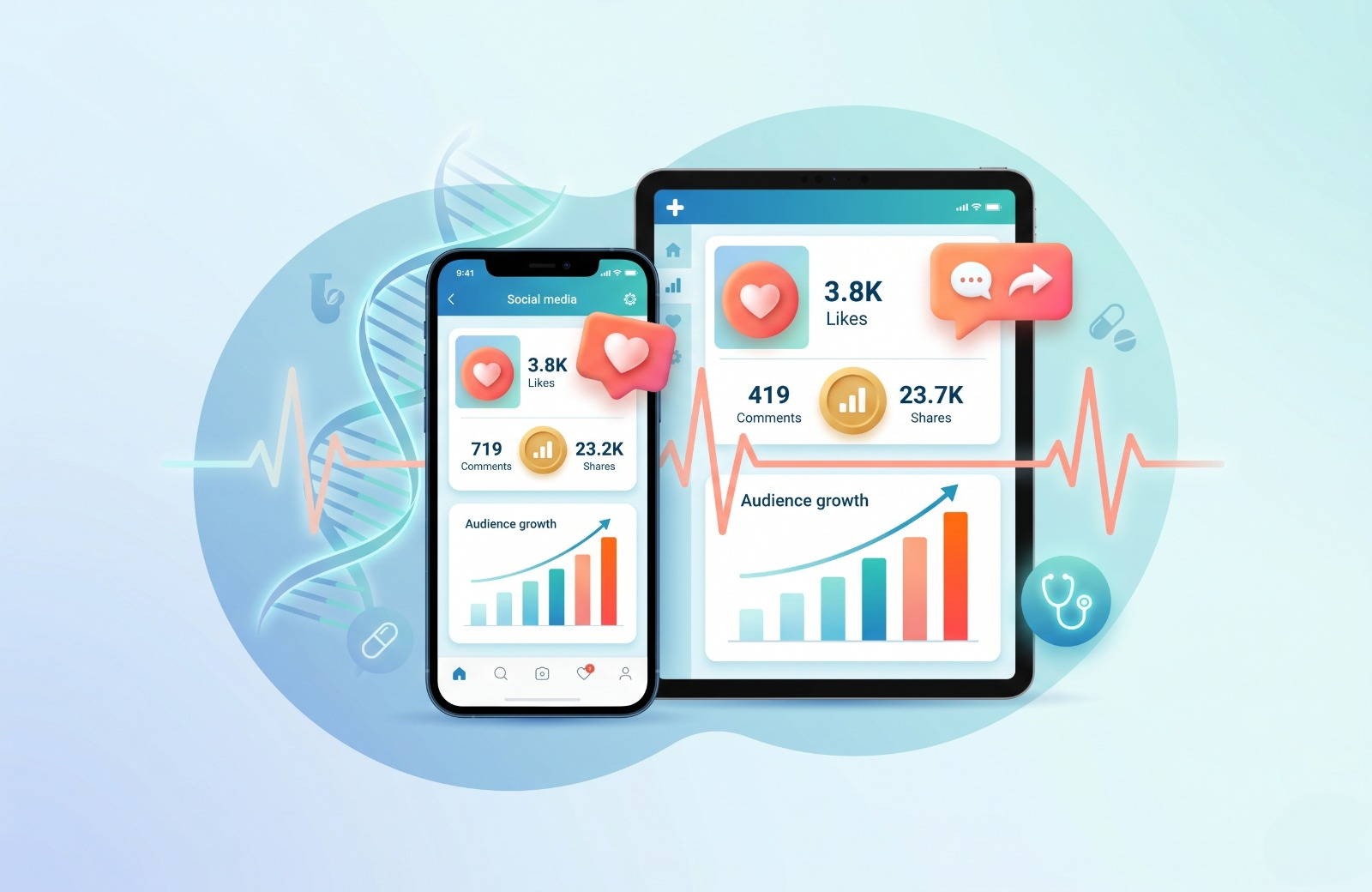
Let's get one thing straight: your patients are on Instagram. But they're not there searching for a diagnostic center. Nobody opens Instagram and thinks "let me find a lab for my CBC test." That's what Google is for. Here's what actually happens: they Google it, a doctor refers them, or a family member suggests a name. And then — almost immediately — they open Instagram to check if the brand feels real. Is there a page? Does it look credible? Does it feel like an actual healthcare brand or a ghost account that last posted in 2022?
Social media doesn't initiate the discovery of a diagnostic brand. It validates it. And that validation moment — that 30-second scroll through your profile — is what seals the booking or loses it forever. That's why having a strong social media content strategy isn't optional for healthcare brands in 2026. It's the difference between a patient choosing you with confidence and quietly moving on to the next result.
01 — Why This Matters Now: Healthcare Brands Can't Afford to Be Boring Online
Social media for healthcare used to be an afterthought — a place to share your clinic's timings and wish people on World Health Day. Today, it's a primary trust-builder in a patient's decision journey.
And here's the key thing most healthcare marketers miss: patients don't discover your diagnostic brand on Instagram — they verify it there. The discovery happens on Google, through a doctor's referral, through word of mouth, or a hospital recommendation. But the very next thing that patient (or their family member) does is open Instagram or Facebook to see if you're real, active, and worth trusting.
Think of your social media presence as your digital waiting room. It needs to feel warm, credible, professional, and human — all at once. Because a dormant page, inconsistent design, or tone-deaf content doesn't just fail to impress — it actively kills confidence right at the moment of decision.
- 83% of patients check a brand's social media before booking an appointment.
- Patients are 4.1x more likely to choose a brand they feel familiar with online.
- 60% of patients say online credibility directly affects their final choice of provider.
The data tells the same story: patients don't pick a diagnostic center on a whim. They pick the one that felt trustworthy before they ever walked in. And in 2026, that trust is built on your digital presence.
🍉 Hot take from Tuskmelon HQ: If your healthcare brand's social page looks like a ghost town — last post from 8 months ago, zero consistency, stock images of syringes — you're not just missing out on growth. You're actively losing patients who were already referred to you. They came to verify, they left unconvinced.
02 — The Foundation: Know Your Audience Before You Know Your Content
Here's where most healthcare brands go wrong: they create content based on what they want to say, not what their audience actually needs to hear. The result? Posts that get three likes (two of which are from the marketing team).
The first step in any social media content strategy for healthcare is ruthless audience clarity. For a diagnostics brand, you're not talking to doctors alone — you're talking to:
- The worried parent — who got a scary report and needs plain-language clarity
- The health-conscious millennial — who books preventive check-ups and follows wellness accounts
- The senior patient — whose family member is the actual social media user making the booking
- The corporate HR team — looking for bulk health packages for their employees
- The referring physician — evaluating lab accuracy and turnaround time
Each of these audiences needs different content, different tone, different value proposition. A single "one-size-fits-all" content calendar doesn't serve any of them well. The best healthcare digital marketing understands one thing deeply: your patient isn't looking for a lab on Instagram. They're looking for a reason to trust you once they've already found you. That's what your content needs to deliver.
03 — The Strategy: The Content Pillars That Actually Convert
A great social media content strategy for healthcare brands is built on a few load-bearing pillars. Get these right and your content machine runs itself.
01 — Education That Empowers
Demystify medical jargon. Explain what a CBC test actually tells you. Break down thyroid levels in a language a 25-year-old can understand. When you educate, you build authority.
02 — Trust Signals
Accreditations, lab certifications, doctor spotlights, behind-the-scenes of sample processing. Trust is built through transparency — show the people and processes behind the brand.
03 — Relatable Health Moments
That meme about skipping a meal and checking Google for diseases? That's your audience. Meet them in relatable moments. Healthcare can be human, even funny — tastefully.
04 — Preventive Nudges
Seasonal content tied to health awareness — monsoon health risks, summer hydration, diabetic diet tips during festivals. Timely, relevant, and always useful.
05 — Patient Stories
With proper consent, real patient journeys build emotional connection and credibility at the same time. Social proof is the most powerful thing in healthcare marketing.
06 — Offers & CTAs (Done Right)
Don't be afraid to talk about health packages and offers — but frame them as care, not commerce. "Your annual check-up is a gift to your family" beats "50% off today only."
🥁 Plot twist: Your healthcare brand's best-performing post might be a meme about forgetting to drink water all day. Relatability is reach.
04 — Platform Playbook: Where to Show Up & How to Behave
Not every platform deserves your energy. Here's the Tuskmelon take on where healthcare brands should focus — and what to do when they get there.
Instagram — Your Trust Validator
Instagram is where patients come to confirm what they already suspect — that your brand is worth it. This is not where they find you; it's where they decide about you. A strong grid aesthetic, consistent posting cadence, educational carousels, real team/facility visuals, and health content that's genuinely useful — that's what converts a referred patient into a booked one. The profile itself is the conversion tool.
Facebook — The Trust Layer
Don't dismiss Facebook — especially for healthcare. It's where the 35–60 age group (a significant patient demographic) still lives. Long-form posts, health event promotions, community groups, and remarketing ads all perform well here. Think of Facebook as your credibility anchor.
LinkedIn — For the B2B Healthcare Angle
If your healthcare brand works with corporates, hospitals, or has a B2B arm — LinkedIn is your playground. Thought leadership articles, case studies, industry insights — position your leadership as voices in the healthcare ecosystem.
YouTube — The Long Game
Healthcare queries on YouTube are enormous. "How to read a blood report" or "What does low haemoglobin mean?" — these get lakhs of views. If you can invest in quality explainer content, YouTube builds evergreen SEO value and deep brand trust over time.
💡 Tuskmelon tip: You don't need to be everywhere. You need to be really good somewhere. Pick your primary platform based on your audience, dominate it, then expand. Master before you scatter.
05 — The Creative Edge: Why Design & Tone Are Half the Battle
Healthcare brands tend to default to one of two mistakes — either they look so clinical they feel cold and unapproachable, or they over-correct and look like a random wellness blog with stock photos of salads. Neither builds brand equity.
What works is a consistent visual identity — a colour palette that's recognisable, typography that's readable, and a design language that feels both professional and human. Every post should look like it belongs to the same family. At Tuskmelon, we call it the "Expert Next Door" voice — someone who knows their stuff completely, but explains it to you like a friend over chai. Not dumbed down. Just human.
Content Formats That Work for Healthcare
- Carousel posts — great for step-by-step guides, "X things you didn't know about Y test", report breakdowns
- Reels / Short Videos — day-in-the-life, myth vs fact, quick explainers, doctor cameos
- Static infographics — data-heavy health information made scannable and saveable
- Stories + Polls — "Do you know your blood type?" gets 10x more engagement than a plain health tip
- User-generated content — reposts, testimonials, patient milestones (with consent)
06 — The Compliance Reality: Marketing Healthcare Without Getting Into Trouble
Healthcare marketing comes with guardrails. In India, the Drugs and Magic Remedies Act, the Medical Council of India guidelines, and platform-specific health advertising policies all apply. This means: no miraculous cure claims, no before-after testimonials that imply guaranteed results, no misleading statistics, and responsible handling of health data.
But here's the thing — good creative strategy never needs to bend the rules. The brands that are winning in healthcare social media do it within compliance. Because authentic, accurate, and empathetic content doesn't need exaggeration. It already performs.
⚖️ Working with a specialist healthcare marketing agency isn't just about getting better content — it's about getting content that's compliant, credible, and won't come back to bite you. This is exactly where Tuskmelon earns its seat at the table.
07 — Measurement: If You're Not Measuring It, You're Just Guessing
A content strategy without measurement is just content creation. The difference between posting and strategically posting is knowing what's working — and why. For healthcare brands, the metrics that matter most aren't vanity numbers like follower count.
- Save rate on Instagram — indicates your content is genuinely useful, not just scrolled past
- Share rate — the ultimate compliment; someone trusted your content enough to send it to their family member
- Story poll & quiz engagement — real-time data on what topics your audience cares about
- Website click-throughs — how much of your social audience is converting to actual enquiries?
- Comment sentiment — are people asking follow-up questions? That's gold.
- Reach of educational content vs promotional content — this ratio tells you everything about algorithm trust
Review your metrics monthly, not just quarterly. Social media moves fast, and a brand that reads its data and adapts is always ahead of one that just posts on schedule and hopes for the best.
08 — The Tuskmelon Way: Why "Digital Done Different" Matters in Healthcare
At Tuskmelon, we don't believe in cookie-cutter content calendars. Healthcare isn't a vertical to us — it's a responsibility. When we work with healthcare and diagnostics brands, we bring together brand strategy, content design, platform expertise, and a genuine understanding of how health decisions are made.
- Strategy first — we don't produce a single piece of content without knowing exactly who it's for, what it needs to do, and how it fits the bigger picture
- Creative that earns attention — not just aesthetically beautiful, but thumb-stopping and purpose-driven
- Results you can actually measure — because engagement is lovely, but brand growth and business outcomes are the real goal
Closing Thought: The Best Time to Fix Your Healthcare Brand's Social Media Was Yesterday. The Second Best Time Is Now.
Social media for healthcare isn't about chasing trends or going viral. It's about showing up consistently, educating meaningfully, and earning a place in your patient's mind long before they ever need you urgently. Because when someone in your city gets a concerning report at 10 PM on a Friday night — you want to be the brand they already know, already trust, and immediately think of.
That kind of brand presence doesn't happen by accident. It's built, post by post, strategy by strategy, with intention and craft. That's exactly what we do at Tuskmelon. Digital done different — for brands that know the difference matters.