
You can post on LinkedIn every single day and still quietly wonder where all the clients are. You can also launch a newsletter, gather a respectable list of subscribers, and then watch it sit there without producing a single real conversation. From the outside, the two formats look almost identical — words on LinkedIn, published by you. But they do very different jobs, and using them interchangeably is exactly why so much LinkedIn effort ends up going nowhere.
The useful question is not which format is better in the abstract. It is which one earns you a client conversation, and when. Get that distinction right and LinkedIn stops being a place you simply post into and hope. It starts becoming a place that reliably produces pipeline, because each format is finally being asked to do the job it is actually built for.
The Core Difference: Reach vs. Relationship
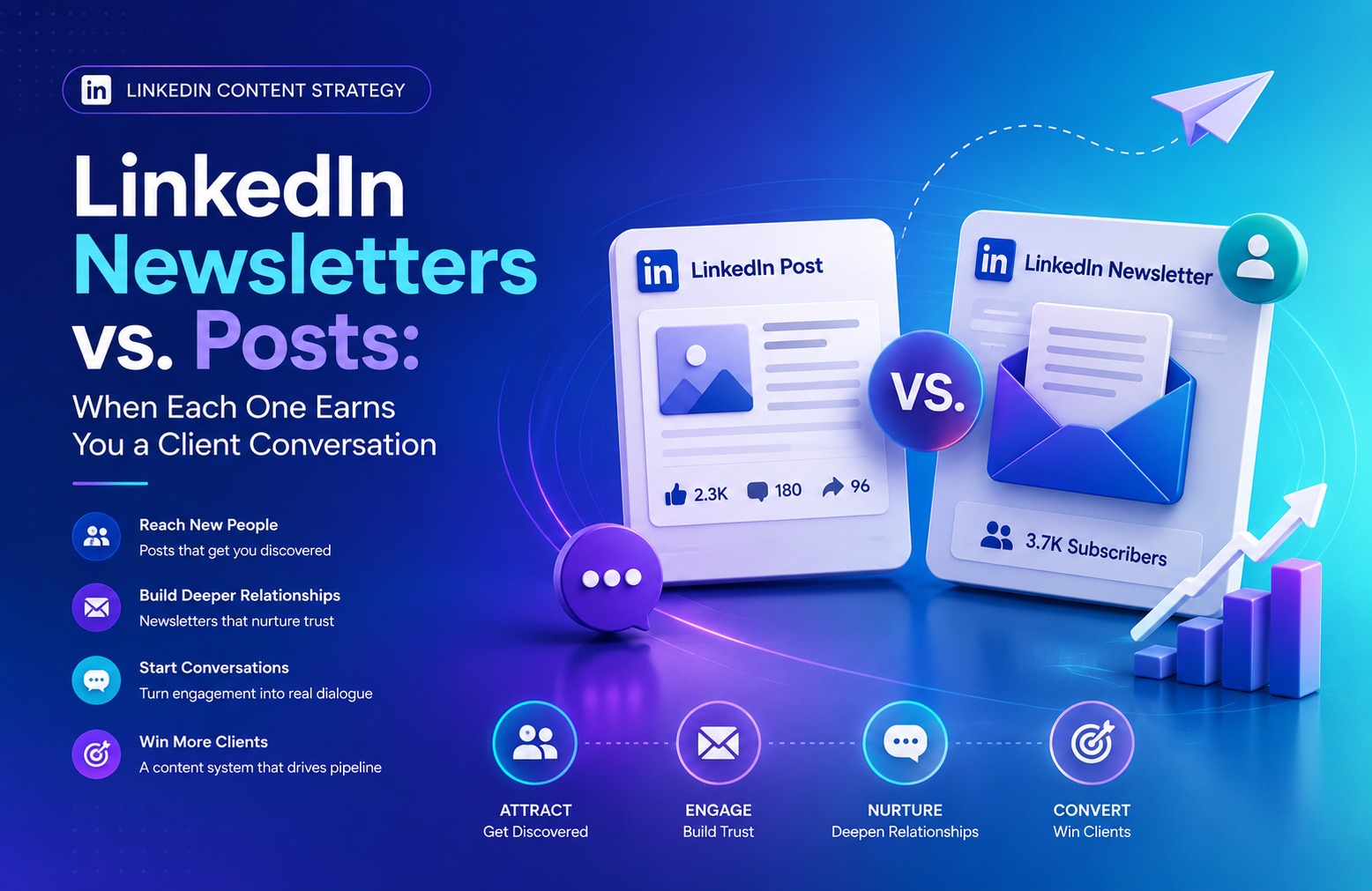
A LinkedIn post is built for reach. It appears in the feed, competes for attention inside a fast scroll, and largely lives or dies within its first few hours. A LinkedIn newsletter is built for relationship. People deliberately subscribe, they get notified when you publish, and they receive your thinking directly, again and again over time. One is a moment that flares and fades. The other is a habit that compounds. Confuse the two and you will keep asking a moment to do the work of a relationship, or a relationship to do the work of a moment.
When a Post Earns the Conversation
Posts are the top of your funnel. They are how complete strangers first bump into your thinking, form an impression, and decide whether you are worth following. A single well-judged post can put you in front of thousands of people who have never heard of you, which is something a newsletter, by its nature, cannot do on its own.
This is also where format matters more than people expect. Document posts and carousels tend to hold attention longer because readers swipe through them, and as a result the LinkedIn document post engagement rate usually runs noticeably higher than a plain text update. That extra dwell time is not vanity — it is more chances for the right person to stop, absorb your point, and act on it.
What a strong post actually earns is rarely a signed deal on the spot. It earns the small openings a conversation grows from:
- A profile visit — someone curious enough to check who you are and what you do.
- A follow — permission to show up in their feed again.
- A comment or a DM — the first genuine two-way signal that interest exists.
Treat posts as the handshake, not the close. Their job is to start relationships at scale, not to finish them.
When a Newsletter Earns the Conversation
If a post is a handshake, a newsletter is a standing appointment. When someone subscribes, they are telling you they want to hear from you regularly — and LinkedIn notifies them every time you publish, so your reach does not reset to zero with each edition the way a post does. That is a fundamentally different, and far stickier, relationship.
Newsletters are where depth lives. They give you the room to develop an argument, share a framework, or walk through a real example properly, which is exactly the kind of substance that builds authority rather than just awareness. Every edition that genuinely lands nudges your LinkedIn newsletter subscription growth upward, and because subscribers compound over time, a good newsletter quietly becomes one of the most durable assets you own on the platform.
Newsletters convert differently from posts, though. They rarely produce a flood of DMs on the day they go out. Instead, they steadily build the kind of sustained credibility that makes a prospect arrive at the eventual conversation already half-convinced — having read your thinking for weeks or months before they ever reach out.
How the Two Actually Work Together
The real mistake is treating this as an either/or choice. In a genuine LinkedIn content strategy for B2B, posts and newsletters are not rivals — they feed each other in a loop. Posts generate the reach that introduces you to new people. Some of those people subscribe to the newsletter. The newsletter then deepens trust with that warmer audience over time, and a portion of them eventually raise their hand.
This loop is the actual engine behind consistent B2B lead generation on LinkedIn: posts to be discovered by strangers, a newsletter to be remembered by the interested, and a deliberate path from both into a real conversation. Neither format does the whole job alone, but together they cover the full distance from stranger to client.
Turning Content Into Client Conversations
Content that never asks for anything rarely produces clients. Plenty of people build genuine audiences and still generate nothing, simply because they never make the next step obvious. Whether it is a post or a newsletter, the content needs a clear, low-friction way for an interested reader to move closer: a direct call to reach out, an offer worth claiming, a profile that instantly explains what you do and how to start.
The honest answer to how to get B2B clients on LinkedIn is not a single viral post that changes everything overnight. It is a system where reach and relationship each have a defined job, where you show up consistently in both formats, and where every piece of content quietly points toward a next step. Do that, and the conversations stop being lucky accidents and start being a predictable output of the work.