
The FMCG playbook is seductive to borrow from. It is fast, colourful, emotionally driven, and it works at genuinely massive scale. So it is very tempting for a bank, an insurer, or a lender to look at a snack brand's viral campaign, see the reach and the buzz, and think: let's just do that. The trouble is that selling a savings account is nothing like selling a soft drink, and the playbook that moves biscuits off shelves quietly falls apart when the product on offer is someone's money.
BFSI — banking, financial services, and insurance — operates under a completely different set of rules. The buying decision is slower, the trust bar sits much higher, and the regulation is real and unforgiving. Copying FMCG tactics wholesale into that world does not merely underperform. It can actively damage the very trust these brands quietly depend on to exist at all.
Two Different Sports, Not Two Speeds of One
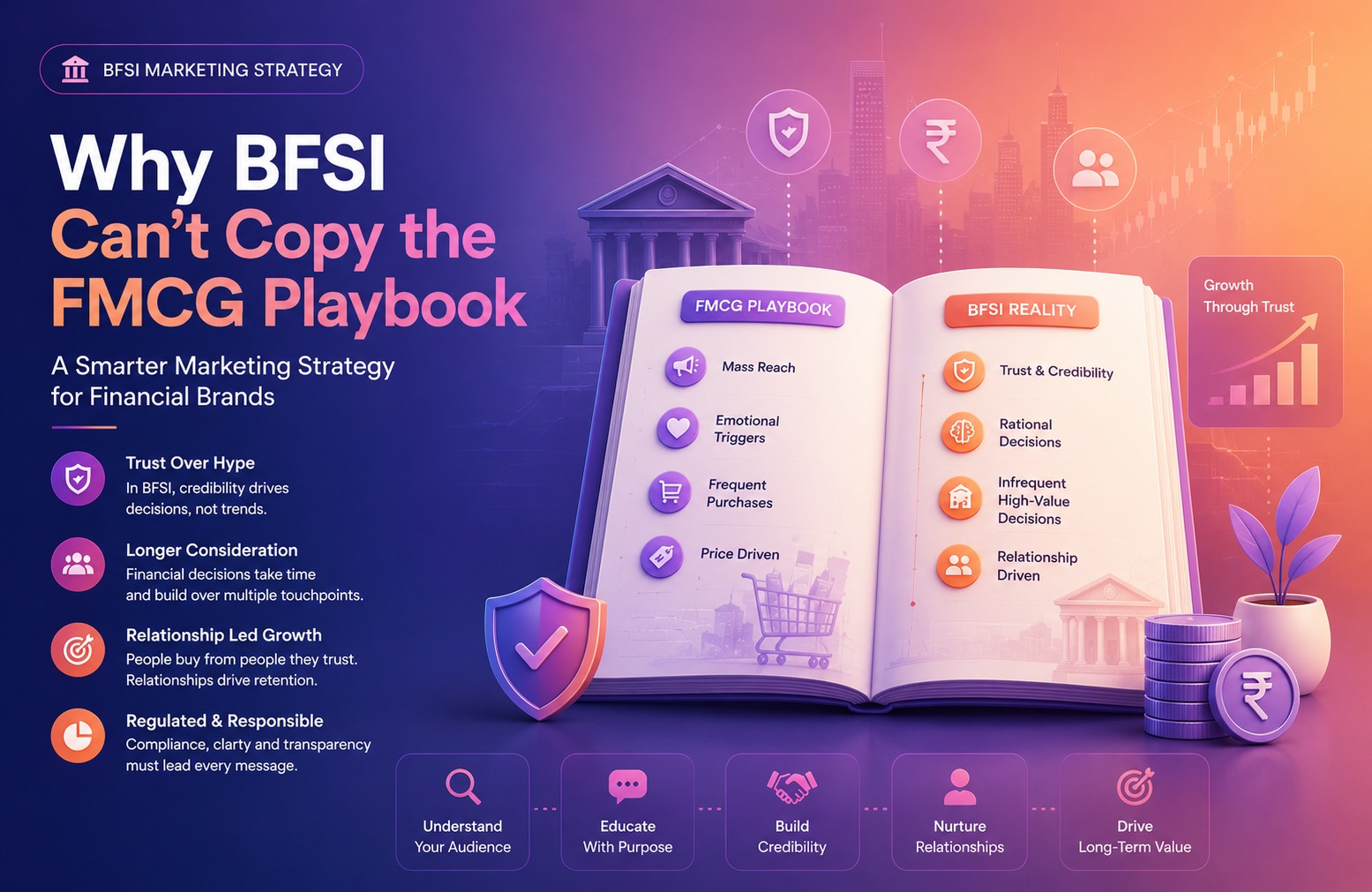
It is tempting to imagine BFSI and FMCG as the same game played at different speeds — as if a home loan were just a slower biscuit. They are not. They are different sports entirely, with different rules, different stakes, and different definitions of winning. An FMCG purchase is often an impulse, made in seconds, at low risk, and easily forgotten if it disappoints. A financial decision is considered, high-stakes, and long-remembered, because getting it wrong has real consequences for the customer's life. Any strategy that ignores that gap starts out broken.
The Trust Gap: You're Asking for Money, Not a Snack
An FMCG purchase asks almost nothing of the buyer. If a new flavour disappoints, they are out a few rupees and they move on without a second thought. A financial product asks for the opposite kind of commitment: their savings, their security, sometimes their future. That raises the trust bar enormously. Before anyone acts, they need to feel genuinely confident that the brand is credible, stable, and honest.
This is why loud, hype-driven creative that works beautifully for a beverage often falls flat, or even backfires, for a financial brand. Where FMCG can lead with emotion and spectacle, BFSI has to lead with credibility and proof. The tone that sells a snack can quietly make a bank look unserious about the one thing customers most need it to be serious about.
The Long Consideration Cycle
Nobody researches a chocolate bar for three weeks. People absolutely do research a home loan, an insurance policy, or where to park their savings — often across many sessions, many devices, and many conversations with family before they ever commit. The journey is long, non-linear, and full of hesitation, comparison, and second-guessing.
This is also precisely why customer acquisition cost in banking runs so much higher than it does in FMCG. It simply takes more touches, more time, and more patient trust-building to convert a single customer, and the marketing has to be designed for that reality rather than for a quick impulse grab. A campaign built to win in one exposure will lose in a category where the real decision happens over weeks.
Regulation Shapes Everything
FMCG brands can make bold, playful, occasionally exaggerated claims, and the worst case is usually a mild eye-roll from consumers. BFSI brands enjoy no such freedom. Every rate, every benefit, every promise is governed by regulators, and mistakes carry real legal and reputational weight rather than just a bad review.
As a result, every piece of financial services digital marketing has to be accurate, compliant, and defensible, with the necessary disclaimers and none of the loose language FMCG can get away with. Far from being a mere hurdle, this discipline is part of the product: customers are, in effect, buying the brand's trustworthiness, and marketing that plays fast and loose with claims undermines the exact thing being sold.
What Actually Works in BFSI
So if the FMCG playbook does not transfer, what does? The approaches that consistently win in BFSI are built around trust, relevance, and precision rather than reach and noise:
- Education over hype — content that genuinely helps people make a confident, informed decision builds far more goodwill than spectacle, and it meets buyers where their real hesitation lives.
- Performance marketing built for long cycles — this is where performance marketing for financial services differs from the FMCG version. Success is measured across a longer funnel, with retargeting and nurturing doing as much of the work as the very first click.
- Personalisation at scale — hyper personalization in financial services means using data responsibly to reach the right customer, with the right product, at the right moment, rather than blasting one generic message at everyone.
- Visible trust signals — security, stability, real customer stories, and clear proof do more to move a financial decision than any clever tagline ever could.
Pulled together, a modern BFSI marketing strategy borrows its discipline from finance itself: measured, evidence-based, patient, and built for the long term rather than the quick spike. The brands that win in this space are not the ones shouting loudest. They are the ones that earn trust methodically and make it effortless for a cautious customer to say yes.