
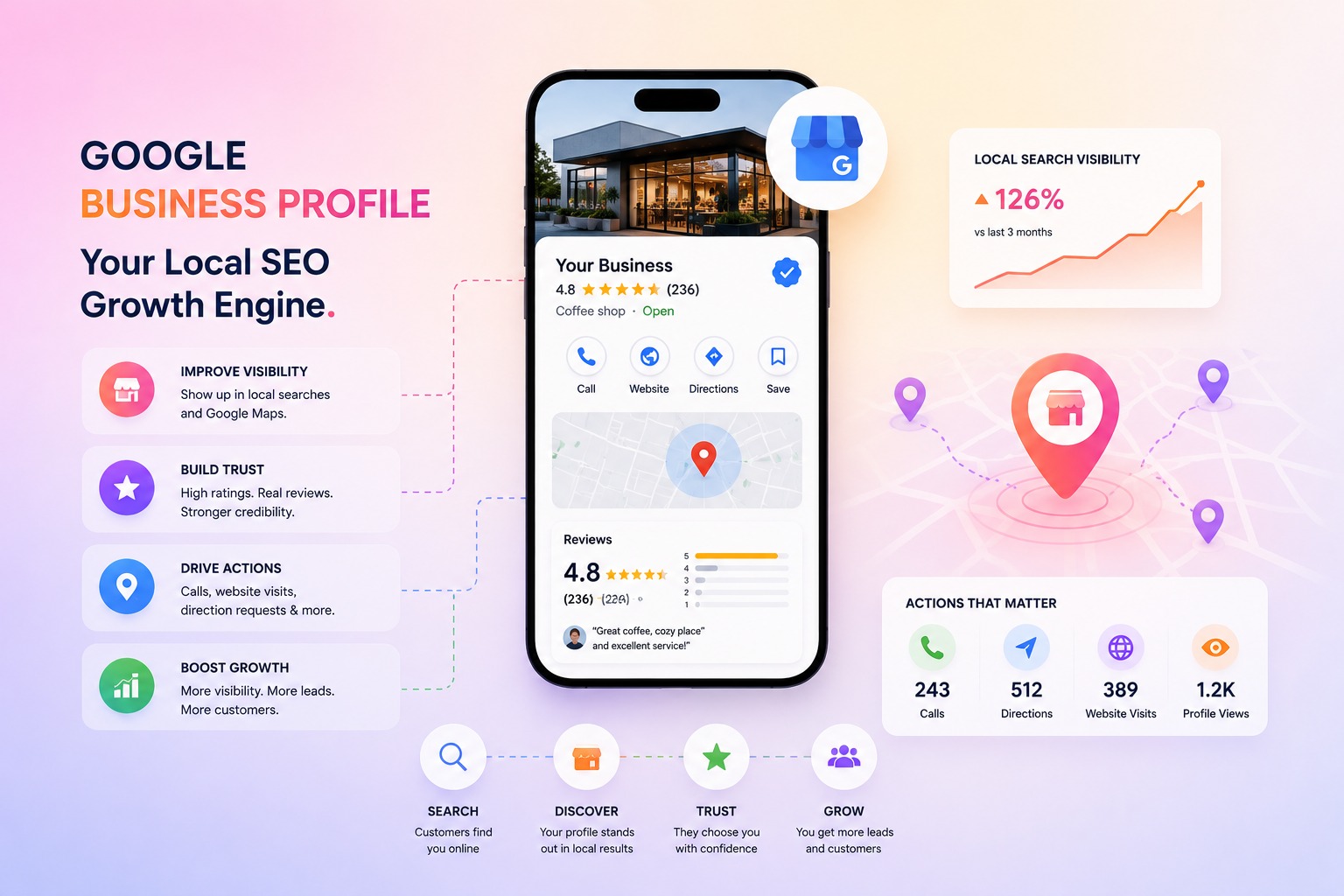
Someone in your city pulls out their phone and types a few words. Within seconds, Google shows them three businesses on a map, complete with star ratings, photos, and a call button. One of them gets the click. The other two may as well not exist. That entire decision happens in the time it takes to read this sentence, and it happens thousands of times a day in every city in India.
That little box — the local map pack — is one of the highest-intent moments in all of marketing. The person searching is not idly browsing. They are ready to act, often within the hour. And what decides who shows up is something many businesses still treat as an afterthought: their Google Business Profile. Get it right and you capture customers at the exact moment they are looking to buy. Get it wrong and you hand them to a competitor who simply set their profile up better.
Wait, Isn't It Called Google My Business?
It used to be. Google retired the "Google My Business" name and now calls it Google Business Profile. Plenty of people, marketers included, still say GMB out of habit, so you will hear both terms used interchangeably. The product is the same idea — your free business listing on Google Search and Maps — just with a new name and far tighter integration directly into Search itself.
The rebrand also signalled Google's intent: managing your profile is now something you do right inside Search and Maps, not in a separate dashboard tucked away elsewhere.
Why "Near Me" Searches Are Pure Intent
There is a meaningful difference between someone searching for information and someone searching for a place to go. When a user types a phrase like "digital marketing agency near me," they are not at the top of the funnel exploring ideas. They are at the very bottom, comparing real options they could contact today and expecting to make a choice quickly.
These searches have exploded as smartphones made location-aware results the default behaviour. People no longer add their city name; they trust Google to know where they are. For any business that serves a city or region — a clinic, a showroom, a bank branch, a restaurant, an agency — ranking in the local pack is often worth more than ranking first in the regular blue-link results below it, because the map pack sits higher and carries the trust signals that push people to act.
The Profile Elements That Actually Move the Needle
Google decides local rankings on three broad factors: relevance, distance, and prominence. You cannot change where your customer happens to be standing, but you can strongly influence the other two. These are the levers that matter most, in rough order of impact:
- Complete, accurate core information — your name, address, and phone number must be identical everywhere they appear online. Even small inconsistencies confuse Google and quietly push you down the rankings.
- The right primary category — choosing the most specific category for your business has an outsized effect on which searches you appear for. Vague or wrong categories are one of the most common reasons good businesses stay invisible.
- Photos that are current and real — profiles with quality, recent images earn far more clicks and direction requests than those without. Stock photos and empty galleries both signal neglect.
- Regular posts and updates — offers, events, and news signal that the business is active and engaged, which Google rewards with visibility.
- Questions answered — the Q&A section is public, and anyone can ask or answer. Leaving it empty or unmonitored is both a missed trust signal and a risk, since incorrect answers can sit there unchallenged.
Reviews: Your Silent Salesperson
Nothing influences local ranking and customer choice quite like reviews. Both the quantity and the quality matter, and so does how recent they are. A steady stream of genuine, recent reviews tells Google your business is alive and trusted, and tells a hesitant customer they are making a safe choice. A profile that earned forty reviews two years ago and nothing since looks frozen in time, while one earning a few fresh reviews every month looks thriving.
The most overlooked tactic is also the simplest: replying to reviews. Responding to every review, positive or negative, shows prospective customers that you genuinely care and gives Google fresh signals of activity at the same time. A calm, thoughtful reply to a negative review can do more for your reputation than ten glowing ones, because it shows future customers exactly how you handle problems when they arise.
Common Mistakes That Quietly Cost You Customers
- Letting the profile go stale — outdated hours during a festival or public holiday turns an eager customer into an annoyed one standing outside a closed door.
- Ignoring negative reviews — silence reads as indifference, and it is the first thing a cautious customer notices.
- Keyword-stuffing the business name — it is against Google's rules and puts your entire listing at risk of suspension.
- Using a call-centre or shared number — it weakens the local relevance that drives "near me" rankings and confuses Google about where you really operate.
Your Google Business Profile is free, but it is not passive. Left alone, it slowly works against you. Treated as a living asset and updated with the same care you give your website or social pages, it can become one of the most reliable sources of qualified, ready-to-buy customers you have, often outperforming channels you actually pay for.